
Table of contents
- What is On Page SEO and Off Page SEO?
- On Page SEO vs Off Page SEO: Understanding the Core Difference
- Difference Between On Page and Off Page SEO Explained
- Why On Page SEO is Important
- Essential On Page SEO Factors
- Why Off Page SEO is Important
- Essential Off Page SEO Factors
- On Page vs Off Page SEO: Which is More Important?
- How On Page SEO and Off Page SEO Work Together
- Common Mistakes to Avoid
- Future Trends in SEO
- Difference Between On Page and Off Page SEO: Detailed Comparison Table
- On Page SEO vs Off Page SEO: Key Activities Comparison
- Important Ranking Factors for Off Page SEO
- Advantages and Disadvantages of On Page SEO
- Advantages and Disadvantages of Off Page SEO
- Quick Summary: On Page and Off Page SEO
- Need Professional On-Page SEO and Off-Page SEO Services?
- FAQs
- 1. What is on page SEO and off page SEO?
- 2. What is the difference between on page and off page SEO?
- 3. Which is better: on page SEO vs off page SEO?
- 4. Can a website rank with only on-page SEO?
- 5. How long does off-page SEO take to show results?
- 6. Why are backlinks important in off-page SEO?
- 7. How often should I update on-page SEO?
Search engine optimization (SEO) is one of the most effective digital marketing strategies for improving online visibility, increasing organic traffic, and generating quality leads. However, many website owners and businesses often get confused what is difference between on page and off page seo and understanding how each contributes to search engine rankings.
If you have ever wondered what is on page SEO and off page SEO, this comprehensive guide will help you understand their differences, benefits, ranking factors, and how to create a balanced SEO strategy that drives sustainable growth.
What is On Page SEO and Off Page SEO?
Before understanding the difference between on page off & page SEO, it is important to define both concepts clearly.
What is On Page SEO?
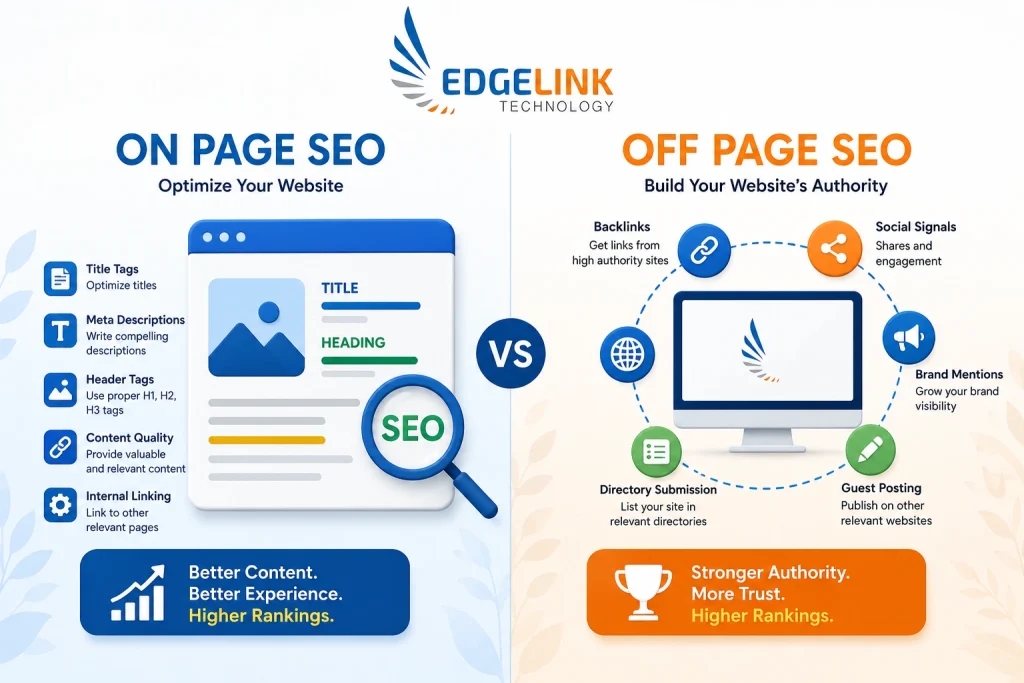
On-page SEO refers to all optimization activities performed directly on your website to improve its search engine rankings and user experience. These optimizations help search engines understand your content and determine its relevance for specific search queries.
Common on-page SEO elements include:
- High-quality content
- Title tags
- Meta descriptions
- Header tags (H1, H2, H3)
- URL structure
- Internal linking
- Image optimization
- Keyword placement
- Mobile responsiveness
- Page speed optimization
The primary goal of on-page SEO is to make your website more relevant and useful for users while helping search engines crawl and index pages efficiently.
What is Off Page SEO?
Off-page SEO includes all activities performed outside your website to improve authority, credibility, and trustworthiness.
The most important off-page SEO factor is backlink building. When reputable websites link to your content, search engines consider your website more trustworthy.
Common off-page SEO techniques include:
- Link building
- Guest posting
- Digital PR
- Social media marketing
- Brand mentions
- Influencer outreach
- Online reputation management
- Local citations
Off-page SEO helps build domain authority and signals trust to search engines.
On Page SEO vs Off Page SEO: Understanding the Core Difference
When discussing on page SEO vs off page SEO, the main distinction lies in where the optimization takes place.
| Factor | On Page SEO | Off Page SEO |
| Location | Inside the website | Outside the website |
| Purpose | Improve relevance and user experience | Improve authority and trust |
| Control | Fully controlled by website owner | Partially controlled by external factors |
| Examples | Content, titles, URLs, speed | Backlinks, mentions, social signals |
| Impact | Helps search engines understand content | Helps search engines trust content |
Both strategies work together and are essential for achieving strong search engine rankings.
Difference Between On Page and Off Page SEO Explained
To fully understand the difference between on page and off page SEO, let’s explore their major components.
1. Content Optimization vs Authority Building
On-page SEO focuses on creating high-quality, relevant, and optimized content.
Off-page SEO focuses on building authority through backlinks and brand recognition.
For example:
- Publishing an informative blog is on-page SEO.
- Earning backlinks to that blog is off-page SEO.
2. Website Structure vs External Signals
On-page SEO improves website architecture and navigation.
Off-page SEO strengthens external trust signals that indicate website credibility.
3. User Experience vs Brand Reputation
On-page SEO directly affects user experience through:
- Fast loading speed
- Mobile friendliness
- Readability
- Navigation
Off-page SEO enhances brand reputation through:
- Industry mentions
- Reviews
- Backlinks
- Social proof
4. Technical Improvements vs Relationship Building
On-page SEO often involves technical optimization.
Off-page SEO requires networking, outreach, and relationship building with publishers and industry experts.
Why On Page SEO is Important
A website cannot rank effectively without strong on-page SEO foundations.
Benefits include:
- Better Search Visibility
Optimized pages help search engines understand content topics and keywords.
- Improved User Experience
Users stay longer on websites that load quickly and provide valuable information.
- Higher Conversion Rates
Proper page structure and content improve engagement and conversions.
- Easier Crawling and Indexing
Search engines can efficiently discover and index website pages.
Essential On Page SEO Factors
- High-Quality Content
Content remains one of the strongest ranking factors.
Effective content should be:
- Original
- Informative
- User-focused
- Well-structured
- Regularly updated
2. Optimized Title Tags
Your title tag should include the target keyword naturally while encouraging clicks.
3. Meta Descriptions
Compelling meta descriptions improve click-through rates from search results.
4. Header Tags
Proper use of H1, H2, and H3 tags improves content organization.
5. Internal Linking
Internal links help distribute authority and improve user navigation.
6. Mobile Optimization
Google primarily uses mobile-first indexing, making mobile optimization essential.
7. Page Speed
Fast websites provide better user experiences and often rank higher.
Why Off Page SEO is Important
While on-page SEO helps search engines understand your website, off-page SEO helps search engines trust your website.
Benefits include:
- Increased Domain Authority
Quality backlinks strengthen overall website authority.
- Higher Rankings
Websites with authoritative backlink profiles generally rank better.
- Improved Brand Awareness
Mentions across the web increase visibility and recognition.
- Referral Traffic
Backlinks from relevant websites can generate targeted traffic.
Essential Off Page SEO Factors
1. Link Building
Acquiring high-quality backlinks remains a major ranking factor.
Focus on:
- Relevant websites
- Authoritative domains
- Natural anchor text
- Editorial links
2. Guest Posting
Publishing valuable content on industry websites can help build authority and backlinks.
3. Digital PR
Digital PR campaigns generate media coverage and quality mentions.
4. Social Media Engagement
Although social signals are not direct ranking factors, they increase content visibility and engagement.
5. Brand Mentions
Search engines increasingly recognize brand mentions as trust indicators.
6. Local SEO Citations
Businesses targeting local customers should maintain consistent listings across directories.
On Page vs Off Page SEO: Which is More Important?
One of the most common questions marketers ask is whether on page vs off page SEO is more important.
The answer is simple: both are equally important.
Think of SEO like building a house:
- On-page SEO creates the structure and foundation.
- Off-page SEO builds trust and reputation.
Without strong on-page SEO, backlinks may not deliver optimal results.
Without strong off-page SEO, even excellent content may struggle to compete against authoritative competitors.
The best SEO strategy combines both approaches.
How On Page SEO and Off Page SEO Work Together
A successful SEO campaign integrates both elements.
Step 1: Create Valuable Content
Develop comprehensive content that satisfies user intent.
Step 2: Optimize the Website
Ensure technical SEO, mobile responsiveness, and page speed are optimized.
Step 3: Build Quality Backlinks
Promote content through outreach and digital PR.
Step 4: Monitor Performance
Track rankings, traffic, engagement, and backlinks regularly.
Step 5: Continuously Improve
SEO is an ongoing process requiring regular updates and optimization.
Common Mistakes to Avoid
On-Page SEO Mistakes
- Keyword stuffing
- Duplicate content
- Missing meta tags
- Poor internal linking
- Slow loading pages
- Ignoring mobile users
Off-Page SEO Mistakes
- Buying low-quality backlinks
- Excessive link exchanges
- Spammy directory submissions
- Over-optimized anchor text
- Focusing on quantity over quality
Future Trends in SEO
SEO continues to evolve rapidly.
Important trends include:
- AI-Driven Search
Search engines increasingly use AI to understand user intent.
- User Experience Signals
Core Web Vitals and engagement metrics are becoming more influential.
- E-E-A-T Principles
Experience, Expertise, Authoritativeness, and Trustworthiness remain critical.
- Semantic Search
Search engines focus more on context rather than exact keywords.
- Brand Authority
Strong brands often gain a competitive ranking advantage.
Businesses that invest in both on-page and off-page SEO will be better positioned for long-term success.
Difference Between On Page and Off Page SEO: Detailed Comparison Table
| SEO Factor | On Page SEO | Off Page SEO |
| Definition | Optimization activities performed within a website to improve rankings and user experience. | Activities performed outside a website to improve authority, trust, and popularity. |
| Focus Area | Website content and technical elements. | Website reputation and authority. |
| Control Level | Fully controlled by the website owner. | Partially controlled by external websites and users. |
| Goal | Improve relevance for search queries. | Improve trustworthiness and authority. |
| Ranking Impact | Helps search engines understand content. | Helps search engines evaluate credibility. |
| Time to See Results | Faster results, often within weeks. | Usually takes longer, often several months. |
| Cost | Generally lower if managed internally. | May require outreach, PR, and content promotion efforts. |
| Measurement | Content rankings, CTR, page speed, engagement metrics. | Backlinks, referring domains, domain authority, brand mentions. |
| Main Objective | Better user experience and content optimization. | Building trust and authority. |
On Page SEO vs Off Page SEO: Key Activities Comparison
| Activity | On Page SEO | Off Page SEO |
| Keyword Optimization | ✓ | ✗ |
| Meta Title Optimization | ✓ | ✗ |
| Meta Description Optimization | ✓ | ✗ |
| URL Structure Optimization | ✓ | ✗ |
| Internal Linking | ✓ | ✗ |
| Content Creation | ✓ | ✗ |
| Schema Markup | ✓ | ✗ |
| Page Speed Optimization | ✓ | ✗ |
| Mobile Optimization | ✓ | ✗ |
| Backlink Building | ✗ | ✓ |
| Guest Posting | ✗ | ✓ |
| Digital PR | ✗ | ✓ |
| Influencer Outreach | ✗ | ✓ |
| Brand Mentions | ✗ | ✓ |
| Social Media Marketing | ✗ | ✓ |
| Online Reputation Management | ✗ | ✓ |
Important Ranking Factors for On Page SEO
| Ranking Factor | Importance | Description |
| Content Quality | Very High | Provides valuable information that satisfies search intent. |
| Search Intent Matching | Very High | Aligns content with what users are searching for. |
| Title Tags | High | Helps search engines understand page topics. |
| Header Tags (H1-H6) | High | Organizes content structure for users and search engines. |
| Internal Links | High | Helps distribute authority across pages. |
| Image Optimization | Medium | Improves page speed and accessibility. |
| Core Web Vitals | High | Measures user experience signals. |
| Mobile Friendliness | Very High | Essential for mobile-first indexing. |
| URL Structure | Medium | Improves readability and crawling. |
| Schema Markup | Medium | Enhances search result visibility. |
Important Ranking Factors for Off Page SEO
| Ranking Factor | Importance | Description |
| Quality Backlinks | Very High | Links from authoritative websites boost trust. |
| Referring Domains | High | Multiple quality domains improve authority. |
| Brand Mentions | Medium | Help search engines recognize brand popularity. |
| Digital PR | High | Generates authoritative mentions and links. |
| Guest Blogging | Medium | Builds backlinks and industry recognition. |
| Social Signals | Medium | Increases content visibility and engagement. |
| Reviews and Ratings | High (Local SEO) | Build trust among users and search engines. |
| Citation Building | High (Local SEO) | Improves local search visibility. |
Advantages and Disadvantages of On Page SEO
| Advantages | Disadvantages |
| Complete control over optimization. | Requires continuous content updates. |
| Improves user experience. | Competitive niches require additional off-page efforts. |
| Faster implementation. | Rankings may plateau without authority building. |
| Helps search engines understand content. | Requires technical knowledge for advanced optimization. |
| Improves conversion rates. | Content production can be time-consuming. |
Advantages and Disadvantages of Off Page SEO
| Advantages | Disadvantages |
| Builds website authority. | Results take longer to appear. |
| Improves rankings for competitive keywords. | Quality link building can be resource-intensive. |
| Increases referral traffic. | Poor-quality links can cause penalties. |
| Strengthens brand reputation. | Less direct control over outcomes. |
| Helps outperform competitors. | Requires ongoing outreach efforts. |
On Page SEO vs Off Page SEO: Which Should You Prioritize?
| Business Stage | Recommended Focus |
| New Website | 80% On Page SEO, 20% Off Page SEO |
| Growing Website | 60% On Page SEO, 40% Off Page SEO |
| Established Website | 50% On Page SEO, 50% Off Page SEO |
| Competitive Industry | 40% On Page SEO, 60% Off Page SEO |
| Local Business Website | Strong On Page SEO + Local Off Page SEO |
Quick Summary: On Page and Off Page SEO
| Feature | On Page SEO | Off Page SEO |
| Improves Relevance | ✓ | ✗ |
| Improves Authority | ✗ | ✓ |
| Optimizes Website Content | ✓ | ✗ |
| Builds Website Trust | ✗ | ✓ |
| Controlled Internally | ✓ | ✗ |
| Requires External Websites | ✗ | ✓ |
| Faster Results | ✓ | ✗ |
| Long-Term Authority Growth | ✗ | ✓ |
| Essential for SEO Success | ✓ | ✓ |
Need Professional On-Page SEO and Off-Page SEO Services?
If you are looking to improve your search rankings, increase organic traffic, and generate more qualified leads, partnering with an experienced SEO agency can make a significant difference.
EdgeLink Technology is a trusted digital marketing agency specializing in:
✅ On-Page SEO Optimization
✅ Off-Page SEO & Link Building
✅ Technical SEO Audits
✅ Local SEO Services
✅ Content Marketing Strategy
✅ SEO Performance Tracking
✅ Enterprise SEO Solutions
Our SEO experts create customized strategies based on your business goals, industry competition, and target audience to help you achieve sustainable growth.
Contact EdgeLink Technology today for a personalized SEO consultation and discover how our proven on-page SEO and off-page SEO solutions can help your business achieve higher rankings, better visibility, and increased revenue.
See the digital marketing Plan and reach Out to Edgelinktechnoloy
Mobile Number : +91 7378795378
Email : info@edgelinktechnology.com
Address : Office No 103, Sanskriti Arcade,Wakad, Pune, Maharashtra 411057
FAQs
1. What is on page SEO and off page SEO?
On-page SEO refers to optimizations performed within a website, such as content, meta tags, and technical improvements. Off-page SEO refers to activities outside the website, such as link building, brand mentions, and digital PR.
2. What is the difference between on page and off page SEO?
The main difference between on page & off page SEO is that on-page SEO improves website relevance, while off-page SEO improves website authority and trustworthiness.
3. Which is better: on page SEO vs off page SEO?
Neither is better on its own. Both are essential for achieving strong search engine rankings and sustainable organic growth.
4. Can a website rank with only on-page SEO?
A website may rank for low-competition keywords using only on-page SEO, but competitive keywords usually require off-page SEO and backlink building.
5. How long does off-page SEO take to show results?
Off-page SEO results can take several weeks to several months depending on competition, backlink quality, and website authority.
6. Why are backlinks important in off-page SEO?
Backlinks act as trust signals for search engines and help improve website authority, rankings, and organic traffic.
7. How often should I update on-page SEO?
Regular audits every few months are recommended to keep content, technical elements, and user experience optimized.

Sharad Mishra
Sharad Mishra is the Director of EdgeLink Technology, a leading digital marketing agency based in Pune. With over 8 years of experience in digital marketing, SEO, Google Business Profile optimization, website development, and performance marketing, he has helped 600+ businesses strengthen their online presence and generate measurable growth. Sharad specializes in healthcare marketing, local SEO, and lead generation strategies, helping brands achieve sustainable digital success.