
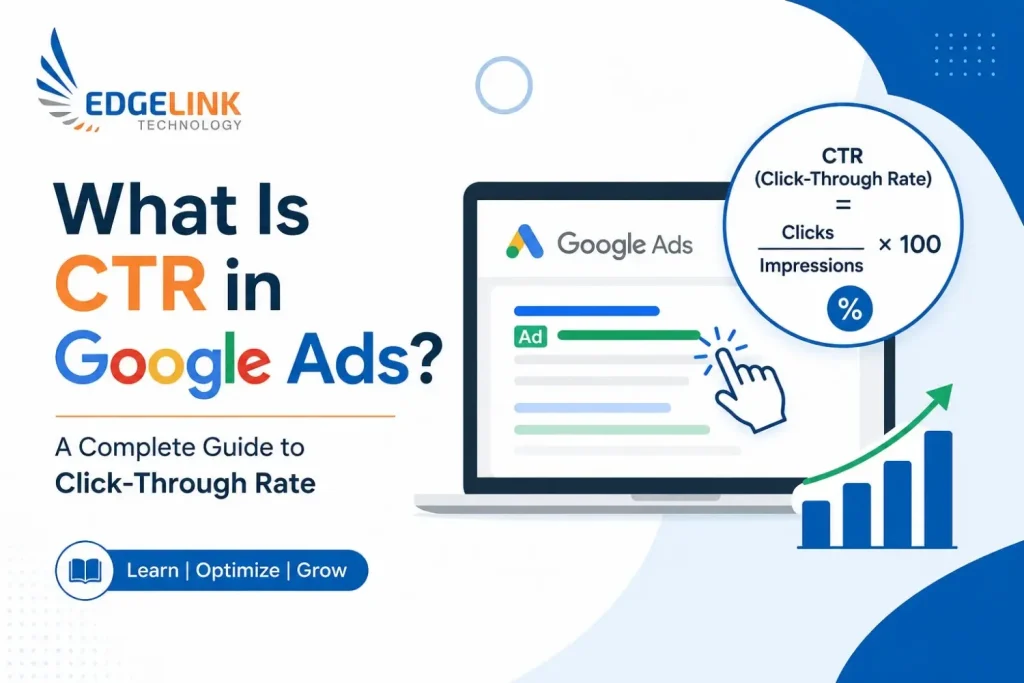
CTR in Google Ads stands for Click-Through Rate the percentage of people who click your ad after seeing it. It is calculated by dividing total clicks by total impressions and multiplying by 100. A higher CTR signals stronger ad relevance, lowers your cost-per-click, and directly improves your Quality Score in Google Ads.
What Is CTR in Google Ads?
CTR, or Click-Through Rate, is one of the most fundamental metrics in Google Ads. It tells you how often people who see your ad actually click on it. In simple terms, it measures the effectiveness of your ad copy and how well your message resonates with your target audience.
When someone searches on Google and your ad appears, that counts as one impression. If that person clicks your ad, that counts as one click. CTR is the ratio of clicks to impressions, expressed as a percentage.
How to Calculate CTR in Google Ads
The formula is straightforward:
CTR = (Total Clicks / Total Impressions) x 100
Example: If your ad received 500 clicks from 10,000 impressions, your CTR is 5%. That means 5 out of every 100 people who saw your ad clicked on it.
What Is a Good CTR in Google Ads?
There is no single universal benchmark for a “good” CTR because it varies significantly by industry, ad type, and campaign goal. However, here are general reference ranges:
| Ad Type / Industry | Average CTR |
| Search Ads (all industries) | 3% – 5% |
| Display Ads (all industries) | 0.35% – 0.5% |
| Healthcare / Medical | 2.5% – 4% |
| Legal Services | 2% – 3.5% |
| E-commerce / Retail | 3% – 6% |
| Real Estate | 2.5% – 4.5% |
If your CTR is below these benchmarks, it usually points to weak ad copy, poor keyword targeting, or a mismatch between your ad and the search intent.
Why CTR Matters in Google Ads
CTR is not just a vanity metric. It has a direct, measurable impact on your advertising costs and campaign performance:
- Quality Score: Google uses CTR as a key input in calculating your Quality Score. A higher Quality Score reduces your cost-per-click (CPC) and improves your ad position.
- Ad Rank: Your Ad Rank determines where your ad appears on the search results page. A strong CTR contributes to a better Ad Rank, even if a competitor bids more than you.
- Cost Efficiency: Higher CTR typically means lower CPC, so you get more clicks for the same budget.
- Relevance Signal: A high CTR tells Google that your ad is relevant to the search query, which reinforces your campaign’s overall performance.
Common Reasons for a Low CTR
Understanding why your CTR is low is the first step to fixing it. Common culprits include:
- Weak or generic headline that does not address the user’s search intent
- Missing ad extensions such as sitelinks, callouts, or structured snippets
- Irrelevant keywords that attract the wrong audience
- Ad copy that lacks a clear call to action
- Broad match keywords pulling in unrelated traffic
- Ads not tailored to the stage of the buyer journey
How to Improve CTR in Google Ads: 8 Proven Strategies
1. Write Headlines That Match Search Intent
Your headline is the first thing a user reads. It should directly reflect what they searched for. Use Dynamic Keyword Insertion (DKI) carefully to include the user’s exact search term in the headline, which increases relevance and CTR.
2. Use All Available Ad Extensions
Ad extensions increase your ad’s real estate on the search results page and give users more reasons to click. Use sitelinks, callouts, call extensions, location extensions, and price extensions wherever relevant. Extensions do not cost extra and consistently improve CTR.
3. Include Numbers and Specifics
Ads with specific numbers perform better than vague claims. “Save 30% on Your First Campaign” outperforms “Save Big on Ads.” Numbers stand out visually and build trust.
4. Add a Strong Call to Action
Every ad should tell the user exactly what to do next. Phrases like “Get a Free Quote,” “Book a Demo,” or “Start Your Free Trial” create urgency and clarity that drive clicks.
5. Use Negative Keywords Aggressively
Negative keywords filter out irrelevant searches. If your ad appears for searches that do not match your offering, your impressions go up but your clicks do not — which tanks your CTR. Regularly audit your search terms report and add negatives.
6. Test Multiple Ad Variations
Run A/B tests with different headlines, descriptions, and CTAs. Use Responsive Search Ads (RSAs) to allow Google to test combinations automatically and serve the highest-performing versions.
7. Segment Your Ad Groups Tightly
Each ad group should contain tightly related keywords and ads written specifically for those keywords. Broad ad groups with mixed intent result in generic ads and low CTR. Smaller, focused ad groups allow for highly specific messaging.
8. Match Ad Copy to Landing Page
While landing page quality does not directly influence CTR, message consistency builds trust. When your ad headline matches what users see on the landing page, they are more confident they have landed in the right place.
CTR vs. Conversion Rate: Which Matters More?
CTR and conversion rate are both critical but measure different things. CTR measures how well your ad attracts clicks. Conversion rate measures how well your landing page converts those clicks into leads or sales.
A high CTR with a low conversion rate means your ad is attracting clicks but the landing page is failing. A low CTR with a high conversion rate means the people who do click are highly qualified, but you are leaving impressions on the table.
The goal is to optimise both simultaneously. Strong ad copy paired with a well-optimised landing page is what drives actual business results.
CTR Benchmarks by Campaign Type
Search campaigns typically yield the highest CTR because users are actively searching for what you offer. Display campaigns have lower CTRs because ads appear on websites where users are not actively seeking your product. Shopping campaigns fall somewhere in between, with CTR driven heavily by product image quality and pricing.
For Performance Max campaigns, CTR is harder to isolate because the campaign runs across multiple surfaces simultaneously. Focus on overall conversion volume and ROAS alongside CTR for PMax evaluation.
Frequently Asked Questions
1. What is a good CTR for Google Search Ads?
A good CTR for Google Search Ads is generally between 3% and 5%, though top-performing campaigns in competitive industries can exceed 10%. The benchmark varies by industry, keyword type, and campaign structure.
2. Does a higher CTR always mean better campaign performance?
Not always. A high CTR is positive when it is paired with a strong conversion rate. If your ad attracts clicks but those clicks do not convert, you are spending budget without ROI. Always evaluate CTR alongside conversion rate and cost per conversion.
3. How does CTR affect my Google Ads Quality Score?
CTR is one of the three main factors in Quality Score, alongside expected CTR, ad relevance, and landing page experience. A higher expected CTR raises your Quality Score, which lowers your CPC and improves your ad position.
4. What is the average CTR for Display Ads?
Display Ads have significantly lower CTRs than Search Ads, averaging between 0.35% and 0.5% across industries. Display is better suited for brand awareness than direct response.
5. Can I improve CTR without increasing my budget?
Yes. Improving CTR is primarily about better ad copy, tighter keyword targeting, more relevant extensions, and removing negative keywords. None of these require additional budget — they require better strategy and execution.
Ready to Improve Your Google Ads CTR? Edgelink Technology Can Help.
A low CTR is costing you money every single day. Whether your ads are getting too few clicks, attracting the wrong audience, or simply not standing out in a competitive search landscape, the problem almost always traces back to strategy, structure, and copy — not budget.
At Edgelink Technology, is digital marketing agency in pune, we specialise in Google Ads management and PPC optimisation for businesses across Pune, PCMC, and beyond. Our certified Google Ads specialists audit your existing campaigns, identify the exact reasons for low CTR, and implement targeted fixes that drive measurable improvement.
Here is what we do for our clients:
- Deep keyword research and negative keyword strategy to attract the right clicks
- Ad copy that is written to match search intent and drive action
- Full ad extension setup including sitelinks, callouts, and call extensions
- Ongoing A/B testing to continuously improve CTR and conversion rate
- Monthly reporting with clear metrics so you always know what is working
If your Google Ads campaigns are not performing the way you expect, it is time to bring in specialists.
book a free Google Ads audit and find out exactly what is holding your CTR back.
Stop paying for impressions that do not convert. Let Edgelink Technology build a Google Ads strategy that works.

Sharad Mishra
Sharad Mishra is the Director of EdgeLink Technology, a leading digital marketing agency based in Pune. With over 8 years of experience in digital marketing, SEO, Google Business Profile optimization, website development, and performance marketing, he has helped 600+ businesses strengthen their online presence and generate measurable growth. Sharad specializes in healthcare marketing, local SEO, and lead generation strategies, helping brands achieve sustainable digital success.