
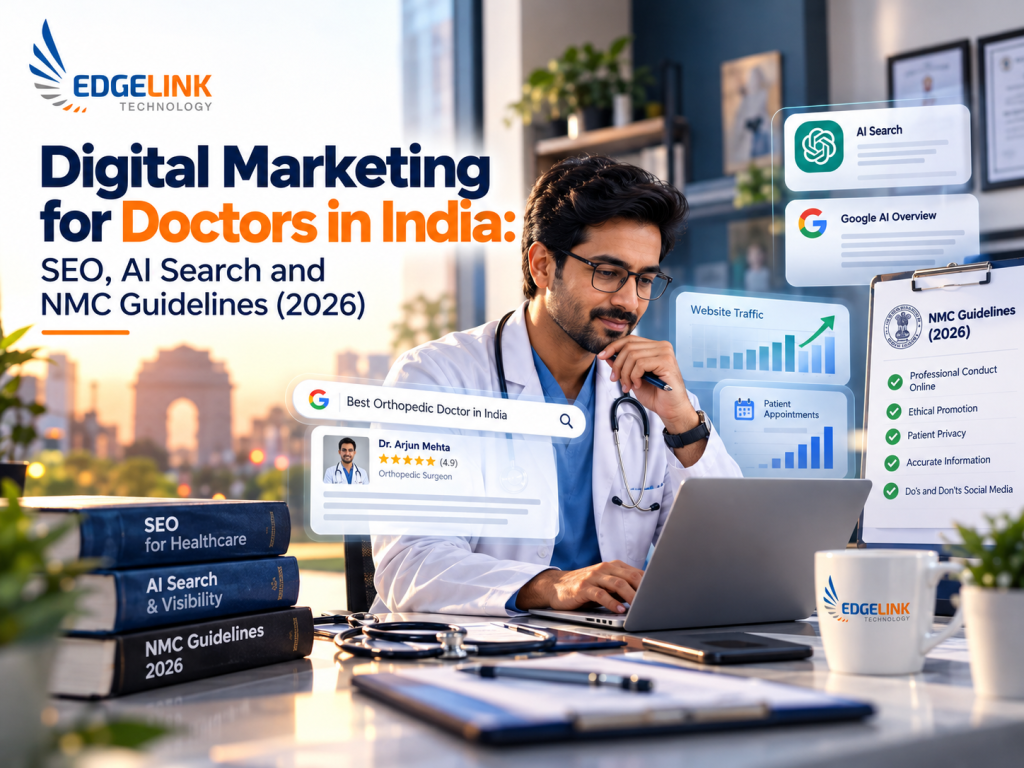
Key Takeaways
- Digital marketing for doctors in India has to be looked at in the context of the professional and regulatory rules that apply to medical advertising.
- The National Medical Commission (NMC) issued guidelines on ethical advertising and public communication by hospitals, medical institutions and registered medical practitioners (RMPs) on 6th October 2026.
- Technical site improvements and accurate institutional information should be treated separately from any promotional activity which may be subject to restriction.
- Healthcare website SEO is about so much more than keywords. It’s about crawlability, the accuracy of the information, the usefulness of the content, the design of the pages and the ability to measure performance.
- Google’s core SEO principles are still very much relevant to AI-assisted search. Nothing in the way of SEO (or AEO or GEO, for that matter) can guarantee that you’ll be included in an AI-generated answer.
- Healthcare organisations looking at getting external support should first of all define the scope of work, the approval responsibilities, the deliverables and the reporting requirements prior to engaging a provider.
What Is Digital Marketing for Doctors in India?
Digital marketing for doctors in India is a catch-all term which encompasses online communication, website visibility and all the various forms of digital activity relating to doctors, clinics, hospitals and medical institutions.
Depending on the context, it may well be SEO, website development, medical information, local search listings, social media, paid advertising and patient-facing communications.
However, these activities are not equivalent from a regulatory perspective. The fact that a doctor’s professional services are promoted online or through an agency does not automatically make that activity permissible.
The NMC guidelines of 6 October 2026 make this distinction particularly pertinent. They deal with advertising and public communication by registered medical practitioners separately from the factual information which hospitals and medical organisations may publish.
The right place to start is to identify the organisation, its communications objectives, the proposed activities and the rules that apply before you go any further and decide which digital services are appropriate.
What do the NMC’s October 2026 Guidelines Mean for Healthcare Websites?
The National Medical Commission issued its Guidelines on Ethical Advertising and Public Communication by Hospitals/Medical Institutions and Registered Medical Practitioners on 6th October 2026.
The guidelines cover professional advertising, promotional communication, patient solicitation and the presentation of medical services.
Rules Relating to Registered Medical Practitioners
Paragraph 8.1(ii) covers advertising restrictions for registered medical practitioners, including (solicitation, self-promotion and use of third parties to market medical services)
This is pertinent when looking at proposals for doctor marketing, social media management, paid campaigns and promotional website copy.
The label you put on a service in no way determines whether it’s allowed. If you call it SEO, branding or website management, that doesn’t in any way take away the requirement to assess what the service actually is and how it will be provided in accordance with the relevant rules.
Factual Information from Hospitals and Medical Institutions
The guidelines deal with factual, objective and verifiable information published by hospitals and medical institutions separately.
Depending on the applicable conditions, this information may include:
- The institution’s name and location
- Contact details
- Departments and facilities
- Emergency services
- Accreditation
- Charges
Institutional information must not be used as a vehicle for prohibited promotion, misleading claims or patient solicitation. The guidelines also cover individual practitioner promotion and promotional claims.
Practical implication: A website review should be able to tell the difference between technical maintenance and actual institutional information and promotional activity. It would be wrong to assume that every SEO task is off limits or that every website-related task is automatically permissible.
The Healthcare Digital Visibility Framework
Hospitals and med orgs should be looking at website visibility through a structured review rather than off the back of a list of keywords or a promise of better rankings.
The following six areas provide a practical framework.
1. Audit Technical Website Health
Search engines have to discover, crawl and index the important pages of a site. Technical problems can make that process more difficult.
A website SEO audit can examine:
- Crawling and indexing: Can the search engines get to the relevant pages, and are those pages in fact indexable?
- HTTP status codes: Are the key pages coming through? Are there any broken URLs?
- Canonical URLs: Are the preferred page versions clearly and consistently defined?
- Metadata: Do the page titles and meta descriptions accurately reflect the content?
- Is the heading structure logical and useful to the reader?
- Internal links: Can users and search engines get to the related content?
- Mobile usability: Is important information easy to access on a mobile phone?
- Performance: Are there any avoidable delays or layout issues?
- Image accessibility: Do meaningful images have appropriate alternative text?
- Security: Is HTTPS properly configured?
A technical audit should be looking at issues in terms of their likely impact and the effort required to fix them. Not all technical warnings are of equal importance, and fixing one issue in isolation doesn’t necessarily result in a ranking improvement.
Google’s SEO Starter Guide outlines the basics of helping search engines understand a website and helping people find the right pages.
2. Keep Institutional Information Accurate
People visiting a health website should be able to identify the organisation and find the right, reliable information without any confusion.
Review whether the website provides accurate and current details about:
- The institution’s name and location
- Contact information
- Departments and available facilities
- Emergency services, where applicable
- Published charges, where appropriate
- Accreditation status, where applicable
- Institutional policies and patient information
- Practitioner details, where applicable and permitted
Remove the obsolete department listings, the incorrect contact details and claims that can’t be verified.
Don’t make unsupported statements such as “India’s best hospital”, “No. 1 doctor” or “100% guaranteed results”. Any claims of superiority, claims regarding treatment outcomes or claims of professional achievement must be viewed with some degree of scepticism in the light of the medical communication rules.
Accuracy is not just an SEO issue. It’s absolutely fundamental to credible communication.
3. Publish Helpful and Reliable Medical Information
Medical information can have a bearing on major decisions, and it should therefore be clear, properly referenced and checked by someone with the relevant expertise.
For health-education content, establish an editorial process that checks:
- Whether the topic answers a genuine reader question
- Whether medical statements are supported by reliable sources
- Whether technical terms are explained clearly
- Whether uncertainty and limitations are communicated
- Whether statistics are presented in the right context
- Whether treatment and outcome claims can be substantiated
- Whether the content receives appropriate medical review
- Whether outdated information is corrected
Don’t publish any false medical qualifications, any fake testimonials, any unproven treatment claims or any made-up success stories.
Google wants helpful, reliable, people-first content that shows appropriate expertise and provides value beyond just rehashing what’s already out there.
For healthcare organisations, content quality should be judged on accuracy and usefulness rather than on word count or keyword density.
4. Assess Local Search and Institutional Discoverability
Local SEO for doctors is a fairly common topic. Any local search activity that you might propose would of course have to be assessed in the first instance against the rules which apply to the practitioner or institution.
For an eligible medical institution, a website and listing review may examine:
- Consistency of the institution’s name, address and contact details
- Accuracy of location information
- Clear descriptions of actual departments and facilities
- Working links to relevant institutional pages
- Mobile access to contact information
- Whether external listings match the organisation’s real-world details
Google Business Profile and the various other local search features should be assessed on the basis of the organisation’s eligibility, the intended use and the relevant professional rules.
Don’t assume that every promotional post, every review request, every paid listing or campaign is appropriate for an individual registered medical practitioner. The purpose of a factual information review is to improve clarity and accuracy, not to make false or misleading claims or to facilitate the unlawful solicitation of patients.
5. Understand SEO, AEO and GEO
SEO is search engine optimisation. Answer engine optimisation (AEO) and generative engine optimisation (GEO) are the terms used to describe approaches which are designed to improve visibility in the answer-based and AI-assisted search experiences, respectively.
For practical purposes, the best starting point is still a technically accessible site with accurate, specific and useful content.
Google’s guidance makes it clear that the basic principles of SEO still apply to its generative AI Search. You don’t need a separate set of AI files, you don’t need content chunking, and you don’t need a special optimisation technique in order to be eligible for inclusion in Google AI Search.
For a healthcare website, priorities include:
- Clear page titles and headings
- Original, relevant content
- Accurate statements supported by sources
- A logical website structure
- Crawlable and indexable pages
- Appropriate images and alternative text
- Useful internal links
- Accurate structured data, where applicable
Adding FAQs, schema markup, or a GEO service will not guarantee that your content will appear in the Google AI Overviews or that it will be used as an answer by ChatGPT and other AI systems.
Measure what can in fact be observed and separate the measured from the estimated.
6. Measure Website Quality and Search Performance
A good website assessment sets the baseline, identifies the issues and defines how the improvements will be measured.
Depending on the project scope and available permissions, measurement may include:
| Measurement area | What to examine |
| Indexing | Whether important pages are indexed |
| Search impressions | Which queries and pages appear in Search |
| Organic clicks | Which pages receive search traffic |
| Technical health | Whether important pages load and function correctly |
| Content accuracy | Whether information is current and verifiable |
| Usability | Whether visitors can find important information |
| Enquiry tracking | Whether permitted contact actions are measured accurately |
Healthcare Website SEO Checklist
- Use this checklist to identify the website issues that need to be addressed. It’s a website quality checklist, not a legal compliance certificate.
- The site gets the institution right, and the location and contact details are correct.
- Published departments and facilities are a reflection of what the institution actually offers.
- The site works perfectly on mobile.
- Page titles and headings do in fact describe the content of the page.
- Key pages are indexable, and the crawl & index settings have been checked.
- Medical information is accurate and has an appropriate level of review.
- Claims are supported and do not purport to guarantee any outcome.
- Patient information and photos are dealt with in accordance with the relevant privacy requirements.
- Website content has been checked in accordance with the relevant professional rules.
- The proposed promotional activity has been looked at prior to launch.
- Reports are based on verified data and use clearly defined metrics.
A Practical 30-Day Website Improvement Plan
The following is a sample project sequence, not a guarantee of rankings or outcomes in the 30-day period. Any activity the permissibility of which is in doubt should be subject to appropriate regulatory review prior to implementation.
Week 1: Establish the Baseline
- Inventory the key website pages.
- Check the accuracy of the institution’s identity and contact details.
- Identify any out-of-date or unsupported claims.
- Review the existing content and the proposed content.
- Record any technical issues that require investigation.
Deliverable: A list of the website pages and content, with a prioritised list of issues.
Week 2: Review Technical SEO
- Check crawling and indexing.
- Review redirects, status codes and canonical URLs.
- Check the page titles, the headings and the internal links.
- Review mobile usability and loading performance.
- Prioritise the problems that are impacting the key pages.
Deliverable: A technical SEO findings report with a list of recommended priorities.
Week 3: Improve Content Quality
- Identify any institutional information that is incomplete or out of date.
- Review the statements for accuracy and for reliable sourcing.
- Clarify the structure of the key pages.
- Define the content review and approval responsibilities.
- Confirm that the proposed changes are in compliance with the relevant rules.
Deliverable: A content quality and information structure plan.
Week 4: Define Reporting and Ownership
- Record the available Google Search Console baseline data.
- Define responsibility for future content updates.
- Document the agreed scope of work for any external provider.
- Establish the reporting definitions and a review schedule.
- Create an action plan on the basis of the findings.
Deliverable: A documented improvement roadmap with owners assigned and specific technical checks that can be measured.
How to Evaluate a Healthcare SEO Provider
Healthcare marketing strategies shouldn’t be assessed solely on the basis of the traffic or attention they generate. The provider’s scope, their processes and their reporting standards are equally important.
Before you engage a provider, ask the following questions.
- What will be delivered? Request a written scope with clearly defined deliverables.
- How will factual information be verified? How will errors and unsupported claims be detected and rectified?
- Who approves the content? We need to be very clear about who is responsible for the medical review and for the regulatory questions.
- How will performance be measured? Agree on definitions for index, impression, click and all the other relevant metrics.
- Which outcomes are not guaranteed? Be wary of any promises of guaranteed rankings, guaranteed patient numbers or guaranteed AI citations.
- How will the data be handled? Make sure that appropriate data privacy and security procedures are in place.
- How will compliance issues be escalated? Establish a process for reviewing activities that may be subject to restriction.
Website SEO Support from EdgeLink Technology Pvt. Ltd.
For hospitals and healthcare organisations looking to assess the technical condition of their websites, EdgeLink Technology’s SEO services could be of relevance (again subject to a clearly defined scope and appropriate regulatory review).
SEO Discovery provides a starting point for the discussion of site visibility, technical issues, keyword opportunities and competitor analysis. Before you go any further, please confirm the proposed deliverables and that the work is appropriate for the institution and its regulatory environment.
Explore SEO Discovery:
Looking to improve your website’s search rankings? Explore EdgeLink Technology’s on-page SEO and technical SEO services to optimize website performance, enhance search visibility, and drive organic traffic.
Explore Website SEO Services:
A professional SEO audit helps identify on-page SEO issues, technical SEO errors, and practical opportunities to improve your website’s search visibility. Explore EdgeLink Technology’s SEO services for actionable recommendations based on your website’s needs, without unrealistic ranking promises or a one-size-fits-all approach to SEO.
Frequently Asked Questions
1. Is digital marketing for doctors allowed in India?
There is no single answer for every activity. The NMC guidance of 6 October 2026 deals with the advertising and promotional communication of registered medical practitioners and separately addresses the publication of factual information by hospitals and medical institutions.
The permissibility of an activity will depend on its purpose, its content and the rules that apply to it.
2. Can a doctor use a digital marketing agency?
Para 8.1(ii) of the October 2026 NMC guidelines deals with the engagement of third parties to market medical services. The doctor or provider would be expected to consider the relevant rules in relation to any proposed engagement.
To describe an activity as SEO, branding or website management in no way makes it acceptable.
3. Can hospitals and medical institutions publish information on their own websites?
The guidelines deal separately with factual, objective and verifiable information published by hospitals and medical institutions (subject to the relevant conditions).
Such information is still subject to the relevant restrictions and must not be used for any prohibited promotion or misleading communication.
4. Can SEO improve a healthcare website’s Google visibility?
SEO can help search engines to find and understand the pages on your site. The key areas to look at are technical accessibility, accurate metadata, useful content and a well-structured site.
However, Google can’t guarantee indexing, rankings or any particular level of traffic.
5. Does GEO guarantee visibility in ChatGPT or Google AI Overviews?
No. GEO is an industry term, not a guarantee of inclusion.
Google’s guidance is all about the basics of SEO, accessible pages and useful content for its own generative AI Search. Results will differ across systems and queries.
6. What should a healthcare website audit cover?
Depending on the scope agreed, the audit will look at crawling, indexing, redirects, canonicals, metadata, internal linking, mobile usability, performance and content accuracy.
Issues should be prioritised on the basis of their practical importance rather than giving equal weight to every technical warning.
7. How should healthcare SEO results be reported?
Reports should use defined metrics and make it very clear whether you’re looking at actual measurements or estimates. Google Search Console will give you some data on impressions, clicks and indexing.
Rankings, patient numbers and AI citations should not be presented as guaranteed outcomes.
8. How frequently should a healthcare website be reviewed?
Review frequency will of course vary from organisation to organisation, depending on how frequently the information changes, the level of technical complexity and the relevant professional requirements.
Contact details and service information should be kept up to date when they do change. Technical and content reviews can be arranged as appropriate based on risk and the availability of resources.
Conclusion
Digital marketing for doctors in India requires more than an SEO checklist. It requires accurate information, a technically accessible website, useful content and a clear understanding of the professional rules governing medical communication.
The NMC’s October 2026 guidelines make it particularly important to distinguish factual institutional information from promotional activities involving individual practitioners. For hospitals and medical institutions, a structured website review can establish a baseline, identify technical issues and create a practical improvement roadmap.
For organisations considering website SEO support, begin with a clearly defined scope, verified information and measurable deliverables. Avoid promises of instant rankings or guaranteed patient enquiries.
To understand your website’s current SEO condition, explore EdgeLink Technology Pvt. Ltd. SEO Discovery service and confirm that the proposed assessment is appropriate for your organisation.

Sharad Mishra
Sharad Mishra is the Director of EdgeLink Technology, a leading digital marketing agency based in Pune. With over 8 years of experience in digital marketing, SEO, Google Business Profile optimization, website development, and performance marketing, he has helped 600+ businesses strengthen their online presence and generate measurable growth. Sharad specializes in healthcare marketing, local SEO, and lead generation strategies, helping brands achieve sustainable digital success.