
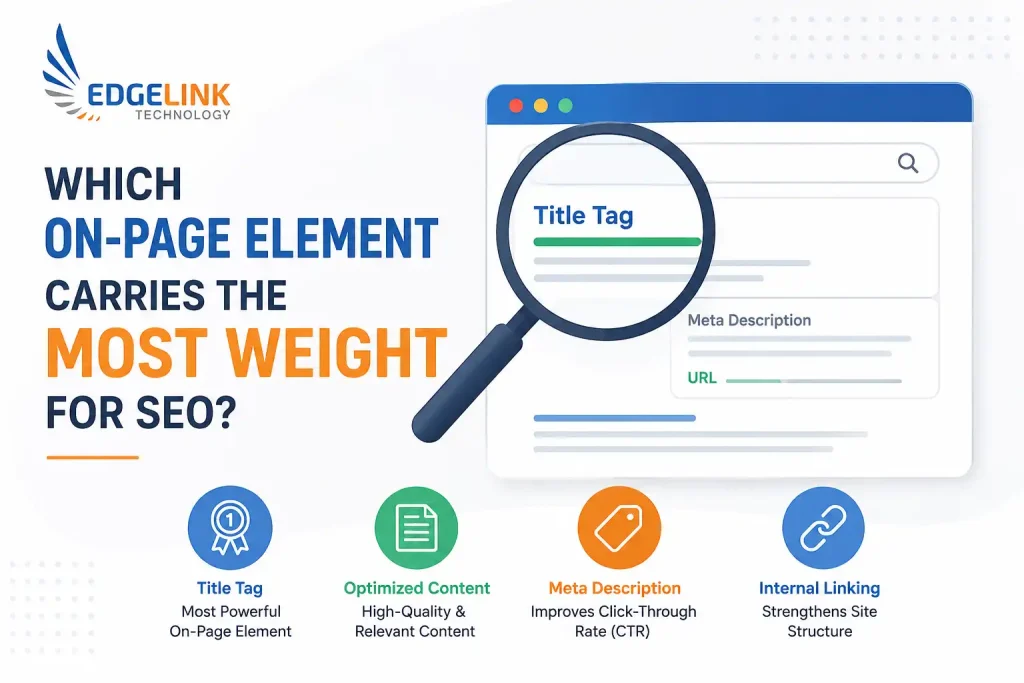
The title tag carries the most weight among individual on-page elements for SEO, since it directly influences both rankings and click-through rate, and it is the first signal search engines and users see for what a page is about. That said, title tags only work as hard as the content behind them lets them. A strong title on a thin or irrelevant page rarely holds its ranking for long. Edgelinktechnology is best website seo agency in pune and all over india apply below the point 100 % gurantee to ranked in SERP
Why This Question Doesn’t Have a One-Line Answer, Even Though People Want One
Ask ten SEOs which on-page element matters most, and you’ll probably get ten slightly different answers, followed by an explanation for why the question itself is a bit oversimplified. That’s not evasiveness. On-page SEO doesn’t work as a ranked list where one element wins and the rest are afterthoughts. It works more like a set of signals search engines cross-check against each other. A page can have a perfect title tag and still get outranked by a page with a weaker title but genuinely better content underneath it.
Still, if you’re prioritising where to put your effort first, especially with limited time or a large site to audit, some elements consistently pull more weight than others. Here’s how they actually stack up.
On-Page Elements Ranked by Practical SEO Impact
| Element | Direct Ranking Impact | Effort to Fix | Priority |
|---|---|---|---|
| Title tag | High | Low | Fix first |
| Content quality and depth | High | High | Fix second |
| Header tags (H1, H2, H3) | Medium | Low | Quick win |
| Internal linking | Medium | Medium | Ongoing |
| URL structure | Low to medium | Medium (risky to change on live pages) | Plan carefully |
| Meta description | Indirect (via CTR) | Low | Quick win |
| Image alt text | Low | Low | Easy to batch |
| Schema markup | Indirect (via rich results) | Medium | High value for effort |
This table isn’t a strict ranking so much as a practical map of where effort meets payoff. Title tags and content quality do the heaviest lifting. Everything else supports them.
The On-Page Elements That Matter, Ranked by Practical Impact
1. Title Tag
The title tag is the closest thing to a single most important on-page element. It tells search engines what the page is about in a concise, weighted format, and it’s usually the first thing a searcher reads in the results. A well-written title tag does two jobs at once: it signals relevance to the algorithm, and it earns the click from a human scrolling through ten blue links.
What makes a title tag strong: the primary keyword placed near the front, a length under roughly 60 characters so it doesn’t get cut off, and language that reflects what someone would actually type into a search bar rather than internal jargon.
2. Content Quality and Depth
If the title tag gets the click, content quality decides whether the page keeps ranking. Search engines increasingly evaluate whether a page actually answers the query comprehensively, whether it demonstrates real expertise, and whether users stick around after clicking through. Thin content with a great title tag might get an initial ranking bump, but it tends to fall back once engagement signals come in weak.
This is where E-E-A-T comes in, experience, expertise, authoritativeness, and trust. A page written by someone who clearly knows the subject, with specific detail rather than generic filler, consistently outperforms generic content over time.
There’s a practical way to test this on your own pages. Read the content and ask whether it could have been written by anyone with a search engine open in another tab, or whether it reflects something only someone with real, hands-on experience in the topic would know. Specific numbers, named tools, actual client scenarios, or a clearly stated methodology all signal the latter. Vague reassurances and recycled definitions signal the former, and search engines have gotten noticeably better at telling the two apart.
Depth matters here too, but not in the way “longer content ranks better” gets thrown around. Depth means covering the subtopics a reader would naturally have follow-up questions about, within the same page, so they don’t have to leave and search again. A page that answers the core question and then anticipates the three or four things someone would ask next tends to outperform a page that answers only the headline query and stops.
3. Header Tags (H1, H2, H3)
Header tags do double duty. They help search engines understand the page’s structure and topic hierarchy, and they help readers scan the page and find what they need without reading every word. A page with one H1 that matches the primary topic, followed by logically nested H2s and H3s for subtopics, tends to perform better than a wall of unbroken text.
4. Meta Description
The meta description doesn’t directly influence rankings the way a title tag or content does, but it has an outsized effect on click-through rate, which indirectly affects performance over time. A meta description that clearly states what the page offers, and includes the target keyword naturally, tends to earn more clicks than a generic or auto-generated one.
5. URL Structure
Clean, descriptive URLs help both search engines and users understand what a page covers before they even click. A URL like /donor-egg-ivf-process tells you more, faster, than something like /page?id=4821. URL structure carries less individual weight than title tags or content, but it compounds with everything else.
6. Internal Linking
Internal links distribute authority across a site and help search engines understand which pages matter most and how they relate to each other. A page that’s well linked internally, with relevant, keyword-rich anchor text, tends to get crawled more often and rank better than an orphaned page with no internal links pointing to it.
7. Image Alt Text
Alt text matters more for accessibility and image search than for core page rankings, but it still contributes to overall topical relevance, especially on pages where images are central to the content. It’s a smaller lever, but an easy one to pull correctly.
8. Schema Markup
Schema doesn’t directly move rankings, but it helps search engines parse page content accurately and can unlock rich results like FAQ snippets, review stars, or breadcrumbs in search listings. Higher visibility in the results often translates to a higher click-through rate even without a ranking change.
So What Should You Actually Fix First?
If you’re auditing a page and can only fix one thing today, start with the title tag. It’s fast to change, it has a clear and measurable impact on click-through rate, and it forces you to clarify what the page is actually about, which often reveals content gaps in the process.
But don’t stop there. A strong title tag pointing to weak content is a short-term fix at best. The pages that consistently rank well combine a clear, keyword-relevant title with genuinely useful, well-structured content underneath it. Treat the title tag as the entry point, not the whole strategy.
Common On-Page Mistakes That Undo Good Titles and Content
Even with a strong title tag and solid content, a few recurring mistakes quietly cap how well a page can perform.
1. Keyword stuffing in the title tag.
Cramming the primary keyword in twice, or stacking it with three close variations, reads as spam to both users and search engines. One clear, natural placement near the front of the title does more work than repetition.
2. Duplicate title tags across similar pages. T
his shows up constantly on sites with location pages or service variations, where every page ends up with a near-identical title. Search engines struggle to differentiate the pages, and often end up ranking the wrong one, or none of them well.
3. Content written for the algorithm instead of the reader.
Pages that read like they were assembled to hit a keyword density target, rather than to genuinely help someone, tend to have poor engagement metrics, which feeds back into weaker rankings over time. The content that actually performs reads like it was written by someone who cares whether the reader gets their question answered.
4. Header tags used for styling instead of structure.
Using an H2 because it “looks right” visually, rather than because it marks a genuine subtopic, confuses the page’s topical hierarchy. If you wouldn’t include a heading in a table of contents for the page, it probably shouldn’t be a header tag.
5. Orphaned pages with no internal links pointing to them. A page can have excellent content and a strong title tag and still underperform simply because nothing else on the site links to it. Search engines rely partly on internal link structure to understand which pages matter, and a page that’s isolated sends a weak signal regardless of its content quality.
Does Google’s Helpful Content System Change Any of This?
It shifts the emphasis rather than replacing the fundamentals. Search engines have moved toward evaluating content for whether it was created primarily to help a specific audience, versus content created primarily to rank in search results. In practice, this reinforces everything above rather than adding a new separate factor to optimise for. A well-written title tag on genuinely useful, expertise-driven content already aligns with this shift. The pages that get penalised under helpful content evaluations tend to be the ones optimised purely for keyword matching with little substance behind them, exactly the pattern the mistakes above describe.
A Quick Way to Audit Your Own Pages
Go through your top ten pages by traffic and ask three questions for each: does the title tag clearly state what the page is about and include the target keyword near the front, does the content actually answer the query better than what’s currently ranking above you, and are your header tags structured logically rather than just formatted for looks. Most SEO problems show up in the answers to these three questions before they show up anywhere else.
Frequently Asked Questions
1. Does the title tag directly affect rankings, or just clicks?
Both. Search engines use the title tag as a strong relevance signal for ranking, and it’s also the primary text that determines whether someone clicks through from the search results.
2. Is content length an on-page ranking factor?
Not directly. There’s no ideal word count that guarantees rankings. What matters is whether the content thoroughly covers the topic and answers the query better than competing pages, regardless of length.
3. Do meta descriptions affect SEO rankings?
Not directly, no. Meta descriptions don’t influence rankings the way title tags or content do, but they strongly affect click-through rate, which is one of the signals search engines factor in over time.
4. How many H1 tags should a page have?
One. A single, clear H1 that reflects the page’s main topic, followed by properly nested H2 and H3 tags for subtopics, gives search engines and users the clearest structure to work with.
5. Can schema markup improve my rankings on its own?
Not directly. Schema helps search engines understand your content more accurately and can unlock rich results in the search listings, which often improves click-through rate even without a direct ranking boost.
6.Should every page target only one keyword?
Not strictly, but each page should have one clear primary focus. Modern search engines understand semantic relevance well enough that a strong page naturally ranks for related terms and question variations around its core topic, without needing a separate page for every keyword variant. Splitting closely related keywords across multiple thin pages usually dilutes relevance rather than strengthening it.
7. How often should on-page elements be revisited?
There’s no fixed schedule, but a reasonable habit is reviewing your top-traffic pages every few months, and any page that’s slipped in rankings sooner than that. Search results shift as competitors update their content, so a title tag or page that ranked well a year ago isn’t guaranteed to still be the strongest option in the results today.
If You Want This Fixed on Your Own Website?
Knowing which on-page element matters most is one thing. Auditing your actual site, fixing title tags at scale, restructuring content that isn’t pulling its weight, and getting the technical details right, is a different job entirely. Edgelink Technology best Digital marketing Agency in pune works with businesses across healthcare, real estate, education, and local services to get exactly this right, page by page.
Contact Details: +91 7378795378

Sharad Mishra
Sharad Mishra is the Director of EdgeLink Technology, a leading digital marketing agency based in Pune. With over 8 years of experience in digital marketing, SEO, Google Business Profile optimization, website development, and performance marketing, he has helped 600+ businesses strengthen their online presence and generate measurable growth. Sharad specializes in healthcare marketing, local SEO, and lead generation strategies, helping brands achieve sustainable digital success.